
Criminal Cases in San Francisco County Courts
The Superior Court of California, County of San Francisco has jurisdiction over local infractions, misdemeanors, and felonies. San Francisco is a consolidated city and county, so there is no separate municipal criminal court with its own case index. The same Superior Court system also handles traffic laws, municipal code violations, and county ordinances, though departments and calendars vary. Most adult criminal matters are heard at the Hall of Justice. Some matters go to the Civic Center Courthouse or the Community Justice Center at the Polk Street Annex. Juvenile matters use the Juvenile Justice Center and are not part of the ordinary adult criminal search.
The Criminal Clerk in Room 101 holds the official case file. A booking charge is not the final guide to that file: the District Attorney may file a different charge, reduce a count, or decline prosecution. The court docket shows what was actually filed and what happened next. Use the court's Criminal Division page and Daily Calendar to identify a hearing department. The calendar is also shown on an electronic monitor outside Room 101 on court days.
San Francisco Criminal Court Locations
The Hall of Justice is the central address for criminal hearings and records, while the Civic Center Courthouse provides some criminal and central court services. The Community Justice Center handles some matters tied to community justice programs. A case number or calendar entry is the safest way to identify the right building because a courthouse address alone does not reveal the assigned department.
The court's Hall of Justice location page shows the main criminal courthouse at 850 Bryant Street between 6th and 7th streets.
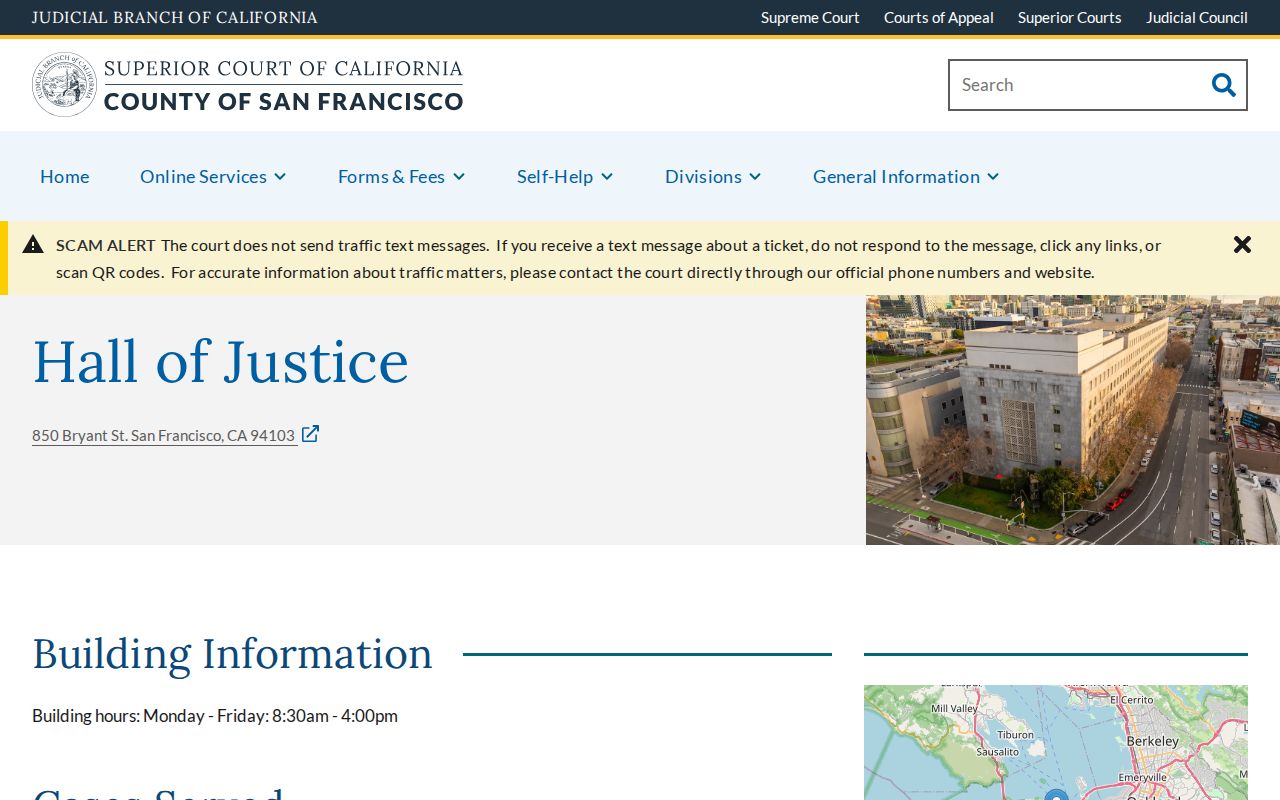
This official location view helps confirm the building before a reader visits Room 101 for a file request or checks a posted criminal calendar.
How to Search San Francisco County Case Records
The free county query is the first stop for San Francisco County criminal case records. It supports searches by case number, defendant name, or attorney name, and the court also publishes a cumulative criminal index that is updated weekly. A match in the index is a lead, not a substitute for every filed document. Complaints, minutes, dispositions, audio, and certified copies follow the clerk's request process.
- Open the Superior Court case information page and choose the criminal query.
- Enter the court case number first when it is known.
- Otherwise, search the defendant's name and compare filing and department details.
- Check the weekly cumulative criminal index if the standard query finds no match.
- Use the clerk form for the exact complaint, disposition, minutes, audio, abstract, or certified copy needed.
| Field Label | Type | Required | Notes |
|---|---|---|---|
| Case number | Text | No | Best path to one court file. |
| Defendant name | Text | No | Use when the case number is unknown. |
| Attorney name | Text | No | Alternative search path documented by the court. |
| Cumulative index | Weekly index | No | Fallback when the regular query does not locate a match. |
| Department/calendar | Calendar | No | Confirms where a hearing is assigned. |
San Francisco Criminal Case Portal
The court announced free online access to criminal case information in May 2024. The online result can show core index details such as a case number, caption, defendant, filing date, case type, assigned department, hearings, docket events, attorney names, and a disposition when entered. It does not establish that every underlying paper is a free download. Sealed filings, restricted material, and private identifiers remain outside the public view.
The official San Francisco criminal case query provides the direct search interface.
The captured interface illustrates why a precise case number gives a cleaner result than a broad name search, especially when names repeat.
What the San Francisco Case File Shows
A San Francisco County criminal case file is a sequence of court events, not a statewide rap sheet. It begins with the filed complaint or other charging paper and grows as the court records hearings, motions, pleas, rulings, judgment, and sentence. The docket is the running list of those events. Minutes record what occurred in court, while a disposition states the outcome of each count. An abstract of judgment or commitment may document the sentence and custody commitment. These records can differ from an arrest report because they reflect prosecutorial filing decisions and later court action.
| Case Number & Court | Identifies the local file, courthouse, and assigned department. |
|---|---|
| Charging Document | Lists the offenses filed by the prosecutor, which may differ from booking charges. |
| Docket Entries | Chronological register of filings, hearings, rulings, and other court events. |
| Hearing Dates | Past and scheduled appearances, subject to calendar changes. |
| Disposition & Judgment | Shows whether counts ended in dismissal, plea, acquittal, or conviction. |
| Sentence & Conditions | Records custody, probation, fines, or other terms ordered by the judge. |
San Francisco Court Copies in Room 101
When the index is not enough, send or bring the Criminal Records Request Form to the Records Clerk, Hall of Justice, 850 Bryant Street, Room 101, San Francisco, CA 94103. The counter is open Monday through Friday from 8:30 a.m. to 4:00 p.m. and closes from noon to 1:00 p.m. The criminal records phone is 415-551-0651. In-person payments may be made by cash, check, Visa, or MasterCard. Mailed requests use a check payable to San Francisco Superior Court and a self-addressed stamped envelope.
The form lists a $40 certification fee, plain copies at $0.50 per page, audio at $25 per case, a $6 standard warehouse retrieval fee, and a $15 search fee when staff time exceeds ten minutes. A mailed check should state “NOT TO EXCEED $50” in the memo; staff contact the requester if the cost will be higher. One request should cover one court number, and incomplete or duplicate requests may delay the work.
The court's criminal records instructions explain the official copy route and the local RAP-sheet prerequisite.
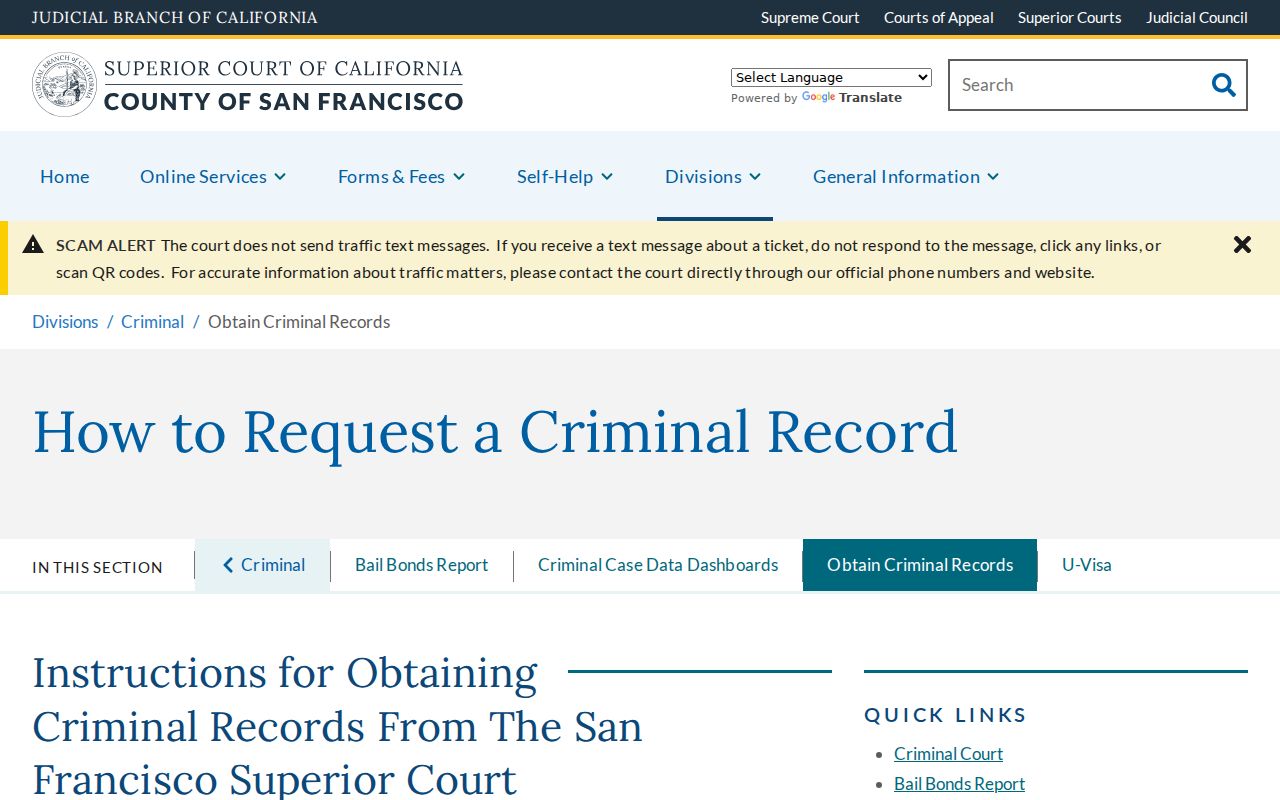
The instructions connect the public index to the clerk counter, where requesters can seek a complaint, disposition, minutes, audio, abstract, or certified document.
Stages of a San Francisco County Criminal Case
The public court file starts when charges are filed, not merely when an arrest occurs. At arraignment, the defendant hears the charge and enters an initial plea. Pretrial entries can include motions, discovery disputes, calendar settings, and diversion decisions. The matter may then resolve through a plea or proceed to trial. A disposition closes each count with its result, and sentencing records the court's order after a conviction. Some San Francisco matters move through Mental Health Diversion, Veterans Justice Court, Young Adult Court, Neighborhood Courts, or other collaborative justice programs, so the docket may reflect treatment or diversion steps rather than a straight path to conviction.
Case flow: Charges Filed › Arraignment › Pretrial › Plea or Trial › Disposition › Sentencing
When San Francisco Requires a RAP Sheet
A name alone may not give the clerk enough detail to locate the right San Francisco County criminal case. If the court number is unknown, the court directs the requester to obtain local RAP-sheet information first from the SFPD Identification Bureau, 850 Bryant Street, Room 475, phone 415-553-1415. The local record can supply the case reference needed for a focused Room 101 request. This is distinct from a California DOJ record review, which is fingerprint based and limited to the subject's own statewide record.
Older files create a second problem. A case may be stored off site even when the index confirms it exists. Mark “View Only” on the request when inspection is enough, but expect the court to apply the listed warehouse retrieval charge when required. For a copy, identify the exact document rather than asking broadly for the whole file. Defendant name, alias, date of birth, arrest date, citation or warrant number, and any known case number help prevent a false match.
Federal Cases in San Francisco
Federal prosecutions are not San Francisco Superior Court cases. They belong to the U.S. District Court for the Northern District of California and use PACER or federal courthouse channels. PACER requires an account for document access and can show docket entries and filed papers in a federal case. A searcher should first decide whether the charge was filed by the San Francisco District Attorney or a United States Attorney. That choice determines which clerk and which case number system apply.
The official PACER listing for the Northern District of California identifies the federal court and its electronic filing system.
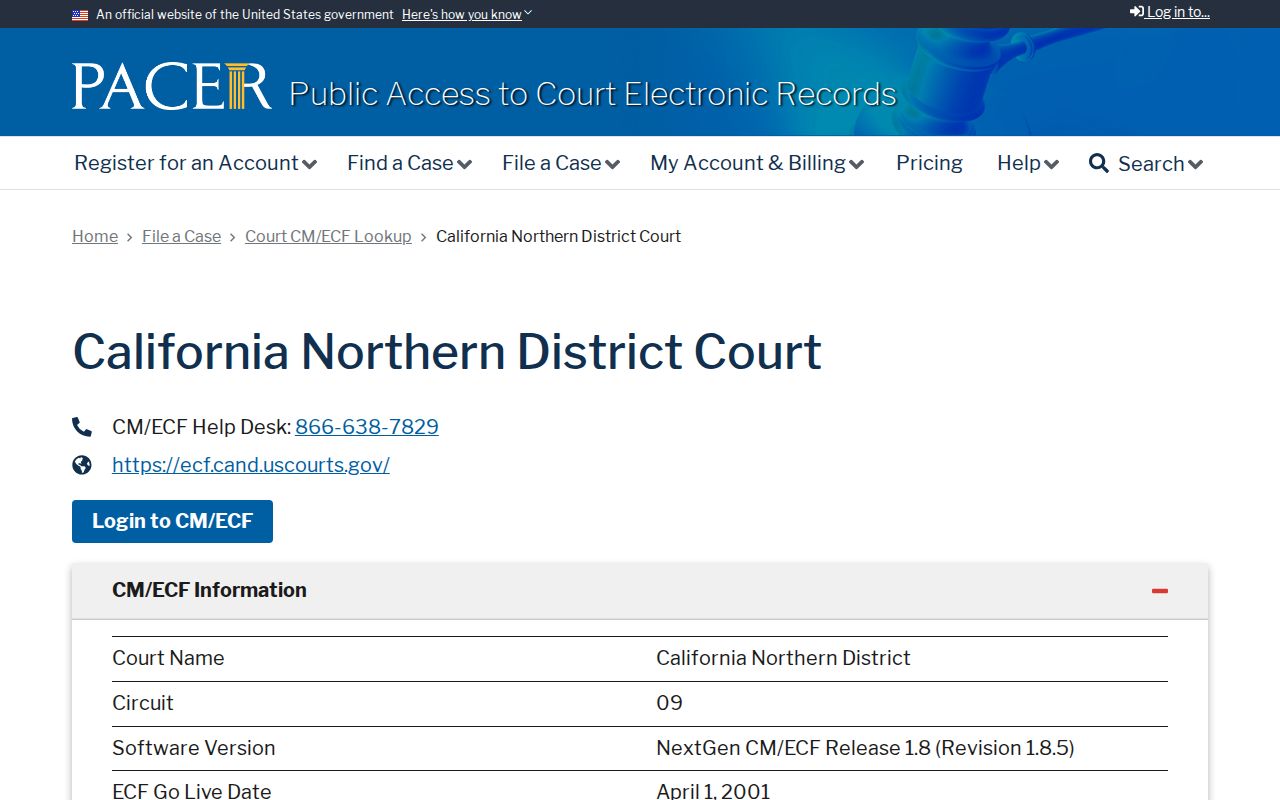
This separate federal entry point prevents a common routing error: searching a county portal for a prosecution that never entered the local Superior Court.
Access & Restrictions
California generally provides public access to court records, but public access does not make every line of every criminal file available online. Sealed matters, juvenile records, protected victim information, confidential identifiers, and filings covered by a court order may be withheld or redacted. A missing portal result can therefore mean several things: the name or number was entered incorrectly, the index is incomplete, the file is older and stored off site, the disposition has not yet been entered, or the case is legally restricted.
Use all documented San Francisco channels before assuming the file does not exist. Search the criminal query, review the weekly cumulative index, check the Daily Calendar, call the Criminal Clerk, visit or mail Room 101, and obtain a local SFPD RAP sheet when no case number is known. Government agencies may fax the court form to 415-551-8085. Members of the public use the regular mail or counter process. The California Public Records Act governs local agency records, but judicial case access follows court rules and sealing law rather than the Sheriff's GovQA process.