
How to Check Criminal History in San Francisco
San Francisco police, jail, and court records describe different stages. Start with SFPD when the goal is an incident report or local RAP sheet. Use the Sheriff for current custody and booking facts. Search the Superior Court when charges may have been filed. The court query accepts a case number, defendant name, or attorney name, and its weekly cumulative index provides another entry point. California DOJ has no general public name search; its official record-review route returns only the requester's own fingerprint-based state history.
- Choose the SFPD incident-copy portal for a police report, or the public-records portal for body-camera video, photos, statements, policy, or statistics.
- Use the SFPD Identification Bureau for local RAP information when no court case number is known.
- Search the Sheriff jail lookup with the first three letters of the first and last names for current custody.
- Search the Superior Court criminal portal for the filed case, then request the complaint, minutes, disposition, or certified copy from Room 101.
- Use California DOJ Live Scan record review only to inspect and, if needed, challenge your own statewide summary history.
A name match is only a lead. Compare dates, case numbers, booking identifiers, charges, and the final disposition before joining records into one San Francisco criminal history.
San Francisco Is the County
San Francisco is the county's only incorporated city. It has no separate city court beneath a different county court, no second municipal police department, and no city jail database apart from the Sheriff system. This makes the agency map compact, but the records are still distributed. SFPD documents the incident. The Sheriff records custody. The District Attorney decides whether to file, and the Superior Court records the prosecution.
The main offices form a local justice corridor. Criminal court records and SFPD local RAP sheets are at the Hall of Justice, 850 Bryant Street, in different rooms. Adult Probation is at 945 Bryant Street. The Public Defender is at 555 7th Street. SFPD report copies, however, are handled at Police Headquarters at 1245 3rd Street. That last move matters because district stations do not issue copies.
The consolidated geography also affects statistics. City and county crime totals often cover the same land, but police incidents, arrests, court filings, and convictions measure different events. An SFPD incident dashboard cannot be read as a count of Superior Court cases. A single incident may lead to no arrest, several arrests, amended charges, or no filed prosecution. Official DOJ OpenJustice and FBI data should be read with the reporting unit and date range in view, then checked against the record source relevant to the individual event.
The San Francisco Police Department
SFPD's Crime Information Services Unit, or CISU, handles incident-report copies through its online process and at 1245 3rd Street, first floor. The records window is open weekdays from 8:00 a.m. to 5:00 p.m., excluding holidays, and the listed phone is 415-575-7232. Copies are free. A requester should provide the SFPD case number and valid identification. Forms are available in English, Spanish, Chinese, Russian, Tagalog, and Vietnamese.
The separate SFPD public-records GovQA portal handles incident-related documentation beyond the basic report, including body-camera material, photographs, statements, statistics, and policies. An account can track a request, and anonymous public-record requests are permitted through that portal. Local RAP sheets and clearance letters do not come from CISU. They go through the Identification Bureau at 850 Bryant Street, Room 475, phone 415-553-1415.
Police reports can be redacted for an active investigation, victim privacy, juvenile information, confidential witnesses, or other legal limits. A released report also does not establish what charges the prosecutor later filed.
District Stations Do Not Copy Reports
Neighborhood district stations can take reports and serve other police functions, but SFPD expressly directs copy requests to CISU at headquarters. Going to Bayview, Central, Ingleside, Mission, Northern, Park, Richmond, Southern, Taraval, or Tenderloin station for a copy can end with a referral to Third Street. This is one of San Francisco's most useful record-access distinctions.
The report-copy request asks for the report type, valid identification, and an SFPD case number when available. A representative may need proof of authority. The GovQA reference number should be saved for follow-up. Traffic collision reports generally should not be requested until at least five business days after the collision. Certain victims covered by Family Code section 6228 may receive qualifying reports within five days and without charge, with in-person identity verification because of sensitive content.
Arrests and Bookings in San Francisco
An SFPD arrest that requires custody moves into the San Francisco Sheriff's jail system. The arresting officer creates the report, while Sheriff staff fingerprint, photograph, classify, and assign booking identifiers. The public jail lookup is best for the narrow question “where is the person now?” It asks for the first three letters of both first and last name. It is not a conviction search and may stop helping once someone is released or transferred.
If the person does not appear, check the Superior Court query for a filed case. The absence of a case can mean charges were not filed, the portal has not updated, or the name search missed the entry. SFPD's report channels may still document the arrest. State prison custody appears in CDCR CIRIS, while federal custody and cases use federal systems.
A booking is not proof of guilt. Charges at arrest may change before filing, and the case can later end through dismissal, diversion, acquittal, plea, or conviction. The detailed San Francisco arrest history channels distinguish those stages and their records.
San Francisco Justice Corridor
The Hall of Justice remains the central criminal-record landmark even after some agencies moved functions elsewhere. The Criminal Clerk's records counter is in Room 101, open weekdays from 8:30 a.m. to 4:00 p.m. and closed noon to 1:00 p.m. The phone is 415-551-0651. Room 475 houses the SFPD Identification Bureau. The close addresses can obscure the fact that these are separate custodians with separate products.
Room 101 supplies court complaints, dispositions, minutes, audio, abstracts, docket viewing, and plain or certified copies. Room 475 supplies local RAP information and letters of clearance. Police Headquarters supplies incident reports. Sheriff GovQA supplies releasable custody and jail records not shown in its lookup. Sending one broad request to the wrong agency does not search the others.
San Francisco Municipal Court Records
San Francisco has no separate municipal court for a city criminal-record lookup. The Superior Court of California, County of San Francisco hears felony, misdemeanor, infraction, traffic-law, municipal-code, and county-ordinance matters. Criminal cases are heard mainly at the Hall of Justice, with some matters at the Civic Center Courthouse and Community Justice Center. Traffic records use Room 145 at 850 Bryant Street, while criminal records use Room 101.
| Court Name | Superior Court of California, County of San Francisco |
|---|---|
| Case Types Heard | Felonies, misdemeanors, infractions, traffic laws, municipal-code violations, and county ordinances |
| Case Lookup Channel | Online criminal case query, weekly cumulative index, or Criminal Clerk records request |
| What the Docket Shows | Case number, filed charges, calendar events, pleas, orders, disposition, and sentence where available |
| Copies & Fees | $0.50 per plain page, $40 certification per court number, $25 audio, $6 standard warehouse retrieval, and $15 for a search over ten minutes |
The court form offers complaint, disposition, audio, abstract, minutes, and other document choices. When no case number is known, court instructions direct the requester to obtain local RAP information from SFPD's Identification Bureau first.
San Francisco Charges After Arrest
The San Francisco District Attorney determines whether a police arrest becomes a prosecuted court case. Its organization includes intake, misdemeanor, felony, major-crimes, vulnerable-victim, collaborative-justice, and post-conviction functions. A police report may use one alleged charge while the filed complaint uses another. That is why the court file, not the arrest line alone, is needed to understand the formal accusation.
The District Attorney's official homepage is shown below as the city charging office in this record chain.
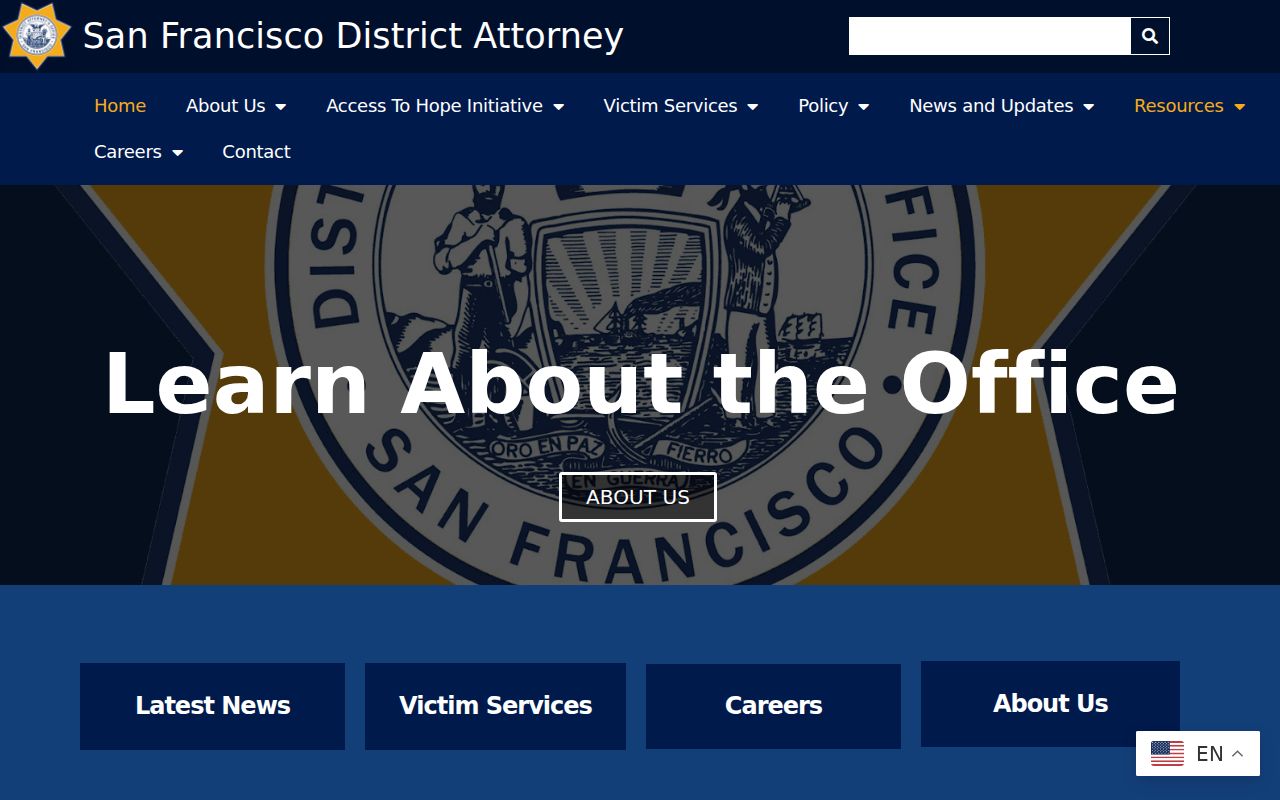
The office's role begins after investigation and continues through case resolution, while the Superior Court remains the custodian of the public case file.
Where San Francisco Records End Up
City records move in sequence, but each custodian retains its own file. SFPD reports the event and arrest. The Sheriff adds booking data when custody follows. The District Attorney may file a case in Superior Court. Court dispositions are then expected to flow back to the California DOJ state summary history. Delays or missing dispositions can make the same event look different across systems.
Record flow: San Francisco Police Department › San Francisco Sheriff › San Francisco Superior Court › California Department of Justice
Recent activity is most visible in police, jail, or court channels. A statewide self-review is best for checking what California DOJ ultimately associated with fingerprints. If the DOJ entry lacks the outcome, obtain the court disposition and follow the DOJ challenge instructions.
San Francisco Probation Record Path
The San Francisco Adult Probation Department supervises local adults ordered to probation. Its main office is at 945 Bryant Street, phone 628-652-2100, and posted hours are weekdays from 8:00 a.m. to 5:00 p.m. Probation case details are not the same as an open public court docket. The court file provides the sentence and orders, while probation controls supervision files and access under its rules.
The official Adult Probation department page is pictured here.
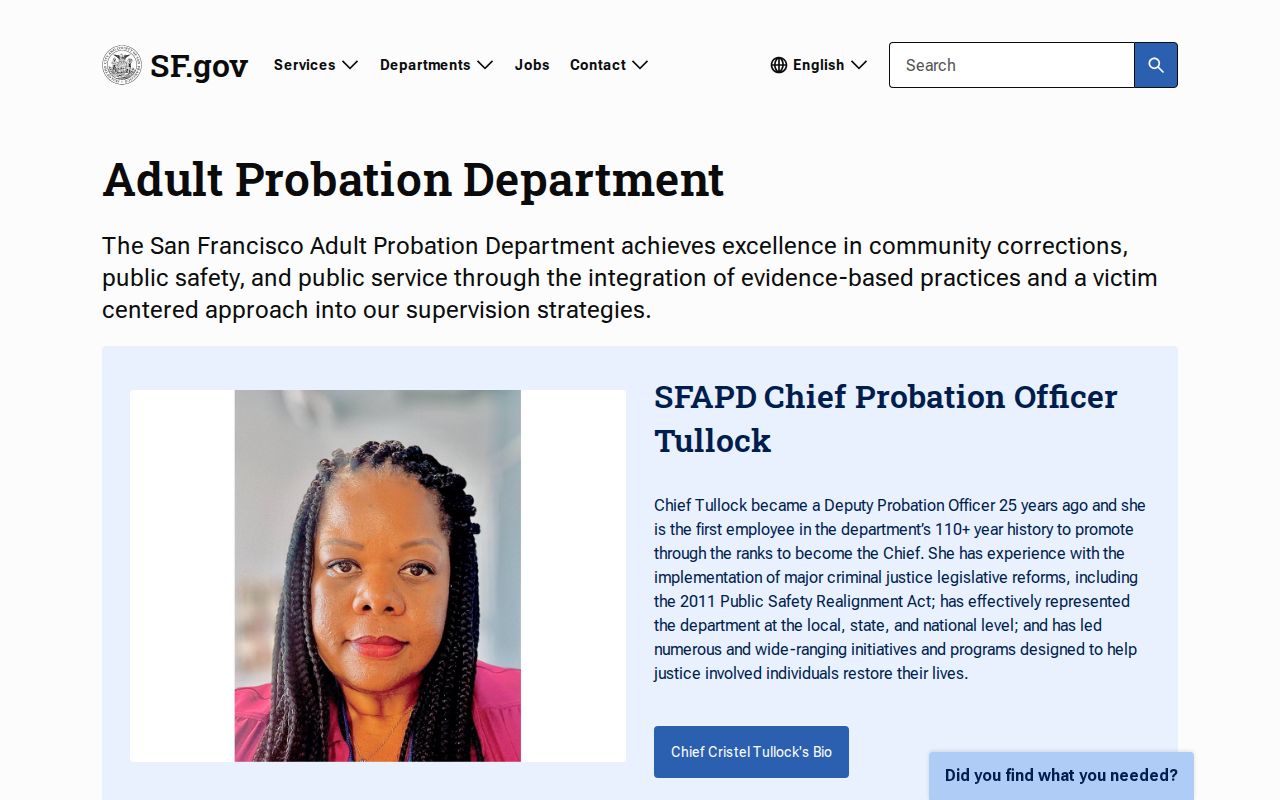
That department page is the right starting point for local supervision services, rather than SFPD or the Sheriff.
San Francisco's current-probation contact instructions provide the address, hours, and phone shown in the next image.
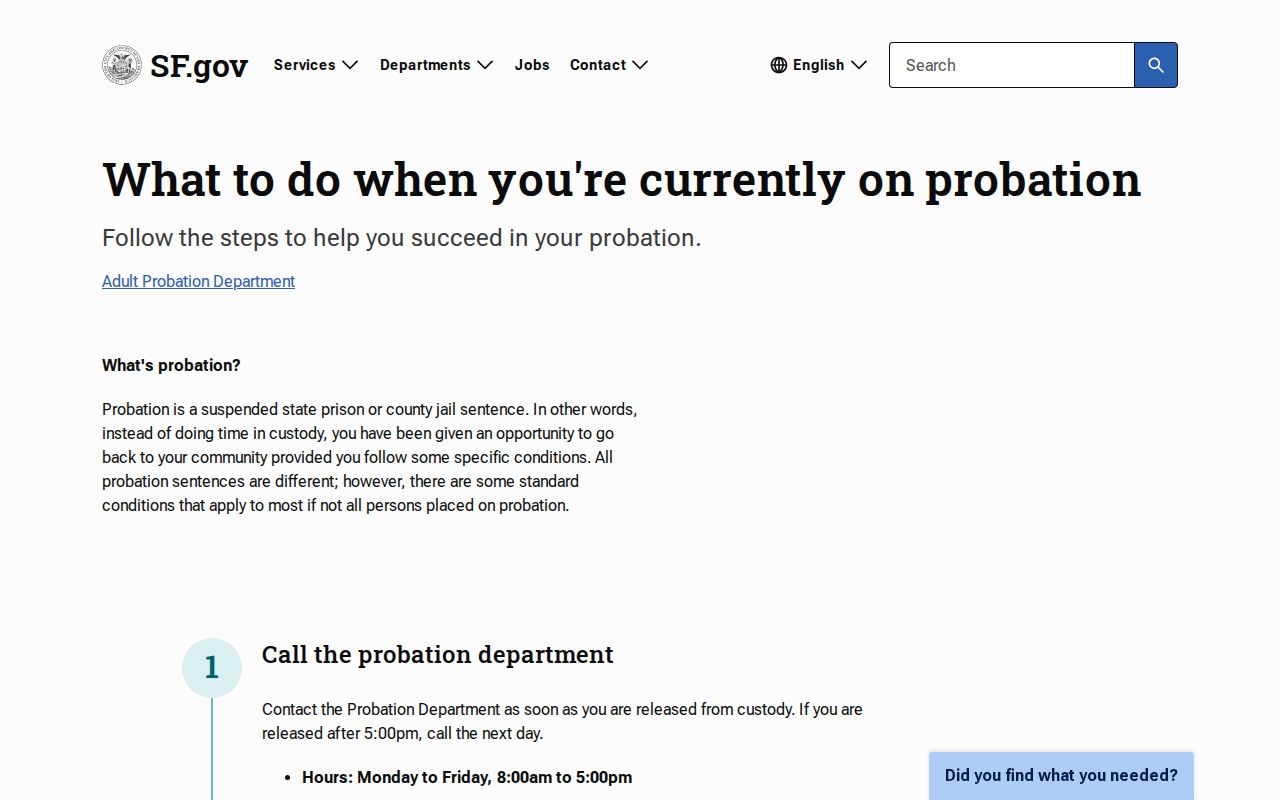
The contact route helps a person reach the supervising department, but certified proof of the criminal sentence still comes from the court.
Clean Slate Help in San Francisco
The San Francisco Public Defender handles local defense services and operates a Clean Slate Program for post-conviction and record relief. Its Clean Slate voicemail is 415-553-9337. California relief may include Penal Code section 1203.4 dismissal, arrest sealing, or automatic relief under other statutes. A section 1203.4 dismissal is often called expungement, but it does not erase every trace of the case.
The Public Defender's official contact directory is shown below.
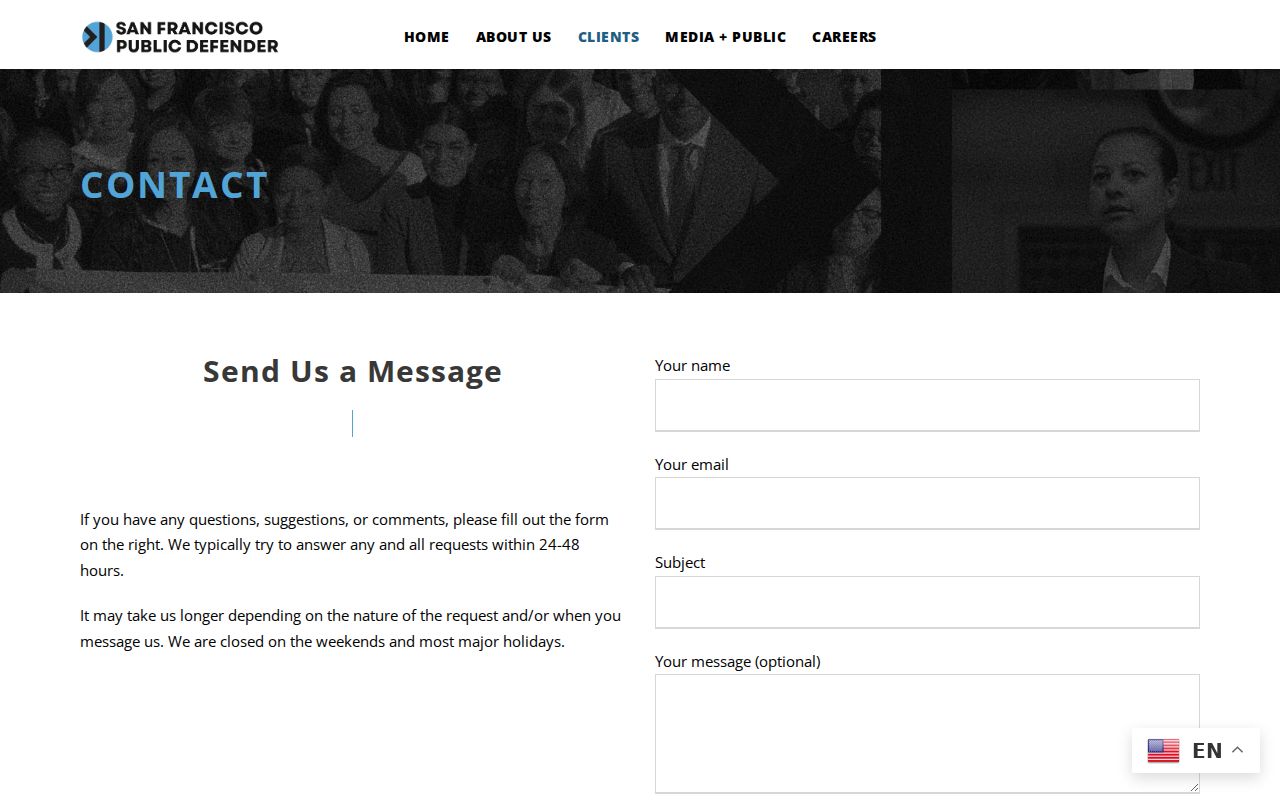
The adult office at 555 7th Street sits within the same justice corridor, while youth and community program offices have separate addresses.
Public Access Rules
The California Public Records Act applies to SFPD, Sheriff, probation, and other local agency records, but exemptions protect active investigations, victims, juveniles, confidential sources, medical facts, and law-enforcement security. Court records follow judicial access rules and sealing orders. State and local summary criminal histories are more restricted than ordinary public records, so a request for a full RAP sheet is not treated like a request for one releasable incident report.
Key Statutes:
California Public Records Act creates the local public-record request framework and allows statutory exemptions.
Penal Code section 11105 limits access to state summary criminal history.
Penal Code section 13300 controls dissemination of local summary criminal history.
Penal Code section 1203.4 provides qualifying dismissal relief without literal erasure.
Use the originating office when context matters. Police records show the event, Sheriff records show custody, and the court disposition shows the legal outcome. A sealed or restricted record may not appear in a public result.